Research
I have conducted both quantitative and qualitative social science research. In the quantitative realm, I have analyzed survey data and conducted real-world experiments with Facebook advertisements to support maple syrup producers and farmers markets, using R and Illustrator for data analysis and visualization. In the qualitative realm, I have conducted semi-structured interviews with Cooperative Extension professionals, using NVivo for data analysis.
Climate Change Communication in Extension
With work spanning agriculture, natural resources, community development, youth development (4H), and more, the Cooperative Extension Service of land-grant universities is the epitome of public engagement with science. For my MS thesis research, I conceptualized and carried out a qualitative study of how Wisconsin Extension educators talk about climate change with communities around the state. I interviewed four Crops & Soils educators, seven Community Economic Development educators, and four Financial Education educators, as well as the program manager in each of those three program areas. My thesis is entitled Talking About Climate Change Without Talking About “Climate Change”: How Wisconsin Extension Educators Approach Climate Change Communication, and you can read it below. A paper based on my thesis has been accepted for publication by the Journal of Extension.
You can watch my thesis defense presentation below.
At the 2024 Association of Science Communicators annual conference, I gave a 15-minute talk about my thesis research and Extension’s public engagement work, which you can watch below.
On a nationwide Extension Financial Security for All webinar about “52 Ways to Climate-Proof Your Finances,” I spoke about my research and gave practical tips for talking about climate change in the financial education context. You can watch the webinar below.
I also spoke about my research and the social science of climate change communication at the North Central Agriculture and Climate Conference on July 31, 2024. That talk was not recorded, but you can see my references and download my slides here.
Wisconsin Maple Syrup Producers
In my work for the Wisconsin Extension Maple Syrup Program, I analyzed a survey with responses from more than 650 Wisconsin maple syrup producers. My portion of the analysis focused on producers’ current operations, motivations for making maple syrup, learning interests, and barriers to expansion. I led a peer-reviewed paper reporting our results, which are summarized in this blog post.
Hershberger, S., Shaw, B., Gorby, T. A., Solin, J., Robinson, P., Tiles, K., Cook, C., & Chang, C.-T. (2024). Comparing Motivations, Learning Interests, and Barriers to Expansion Among Non-commercial and Commercial Maple Syrup Producers in Wisconsin. Small-Scale Forestry, 23, 127–157. https://doi.org/10.1007/s11842-023-09557-9 (free PDF at https://rdcu.be/dsm19).
I also contributed to the report that Extension published on the full results of the survey.
Chang, C.-T., Gorby, T. A., Hershberger, S., Robinson, P., Shaw, B., & Solin, J. (2024). Opportunities to Expand Maple Syrup Production in Wisconsin: Results from a Statewide Survey of Maple Syrup Producers. University of Wisconsin–Madison Division of Extension Maple Syrup Program. https://maple.extension.wisc.edu/files/2024/05/Survey-report-Wisconsin-Extension-Maple-Program-5-13-2024.pdf
Building on our findings about what motivates people to make maple syrup, we ran a Facebook advertising experiment to encourage more Wisconsinites to begin producing maple syrup. We tested four different message frames: building community, food self-sufficiency, spending time in nature, and the lifestyle of working the land. Our ads were seen by more than 300,000 Wisconsinites, more than 5,000 of whom clicked on the link. I led the design, implementation, analysis, and writing of this project, which was published open access in a peer-reviewed journal.
Hershberger, S., Shaw, B., Moen, S., Johnson, T., & Gorby, T. (2024). Promoting small-scale maple syrup production on Facebook: A field experiment testing emphasis message frames. Journal of Agriculture, Food Systems, and Community Development 13(4), 1–26. https://doi.org/10.5304/jafscd.2024.134.012


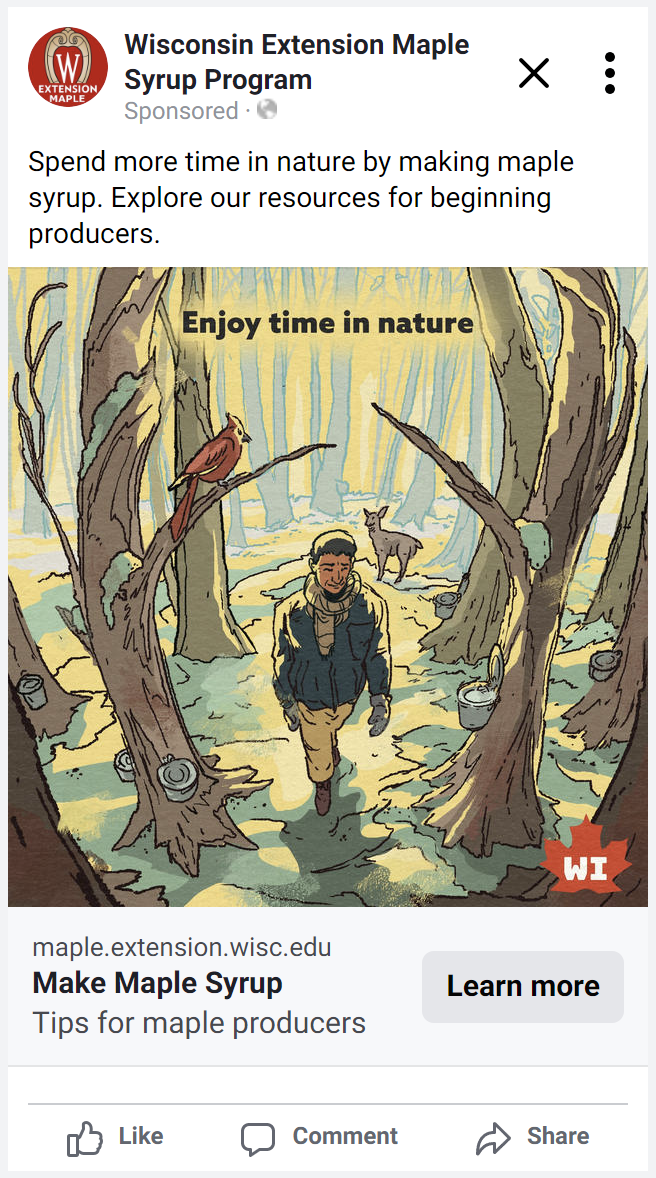

Framing maple syrup production in terms of the lifestyle of working the land was the most cost-effective message overall. Among people ages 18-54, this frame also attracted the most clicks. However, among people ages 55+, framing maple syrup production as a means of food self-sufficiency generated more clicks than the other frames, while emphasizing the time in nature involved in producing maple syrup led to the most public engagement. Our results can inform strategic messaging for future outreach aimed at bringing more people into the world of maple syrup production. Our methods can serve as a blueprint for science communicators seeking to rigorously test the effectiveness of different message frames on social media.
Growing the Customer Base for Farmers Markets
Most recently, I worked on a project with the University of Wisconsin–Madison and the Farmers Market Coalition to encourage more consumers to go to farmers markets. My role was to coordinate partnerships with 12 farmers markets across 6 states, to run $12,000 of Facebook and Instagram advertisements on behalf of the markets, and to analyze the data.
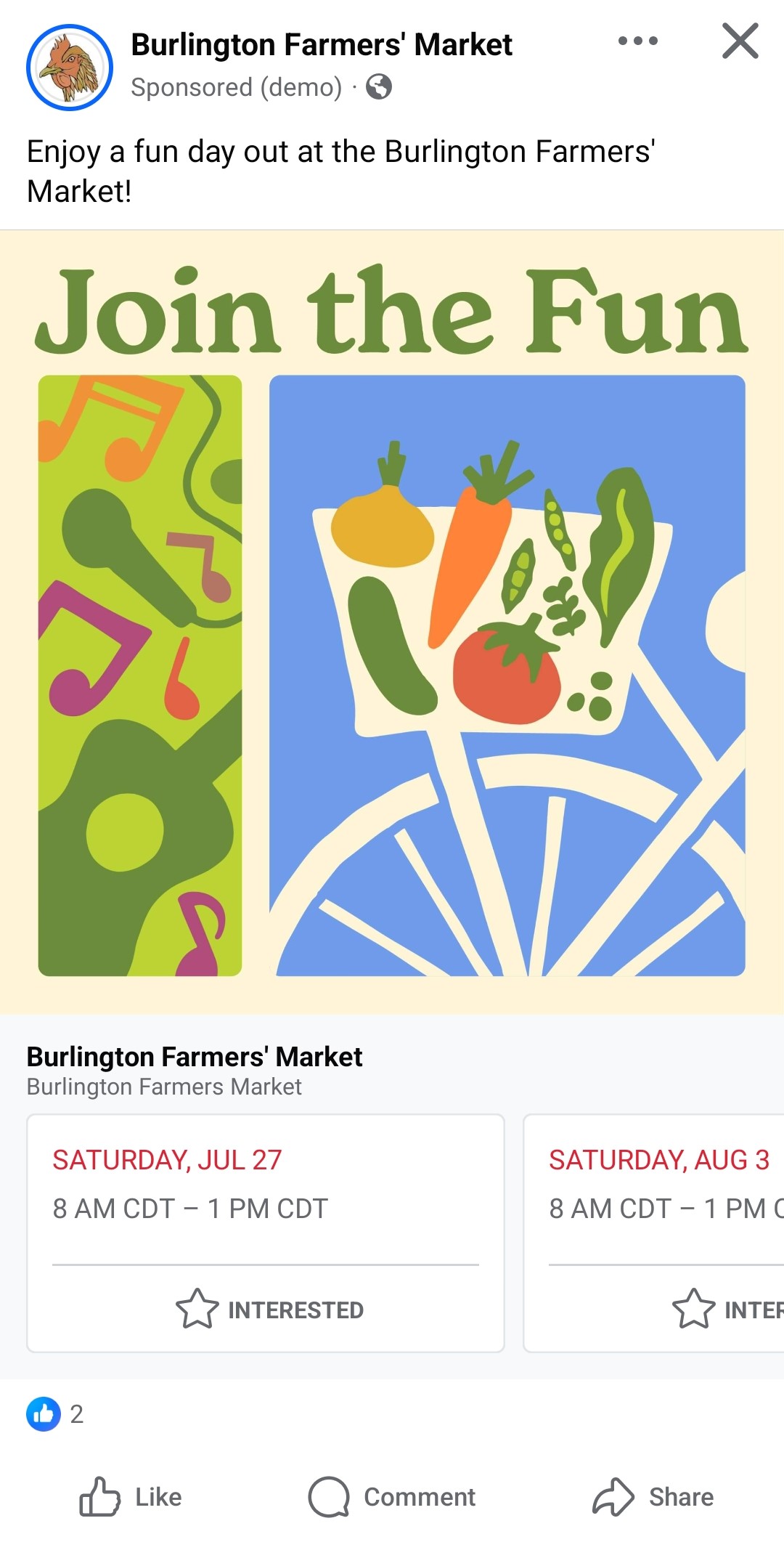
Our first ad campaign tested four different message frames related to consumers’ primary motivations for attending farmers markets: to have fun, to support local farmers, to get fresh and healthy food, and to get sustainable food. The ads were seen by more than 165,000 Facebook users. The “fun” frame was the most successful at getting people to express interest in attending their local market, with “local farmers” performing second-best. The team plans to write a peer-reviewed paper about the project.


For our second ad campaign, we used both Facebook and Instagram to spread awareness that shoppers can use SNAP/EBT benefits at the markets.


 Scott Hershberger